Venture — P-01
Cosmo
Custom AI systems for hospitality operations. Built around the tools and workflows already running the business.
Hospitality businesses already have the software. Their teams still carry the business between it: moving context across systems, remembering the next handoff, and turning reports into action. Cosmo builds dependable AI systems that complete that work across the tools the operation already uses.
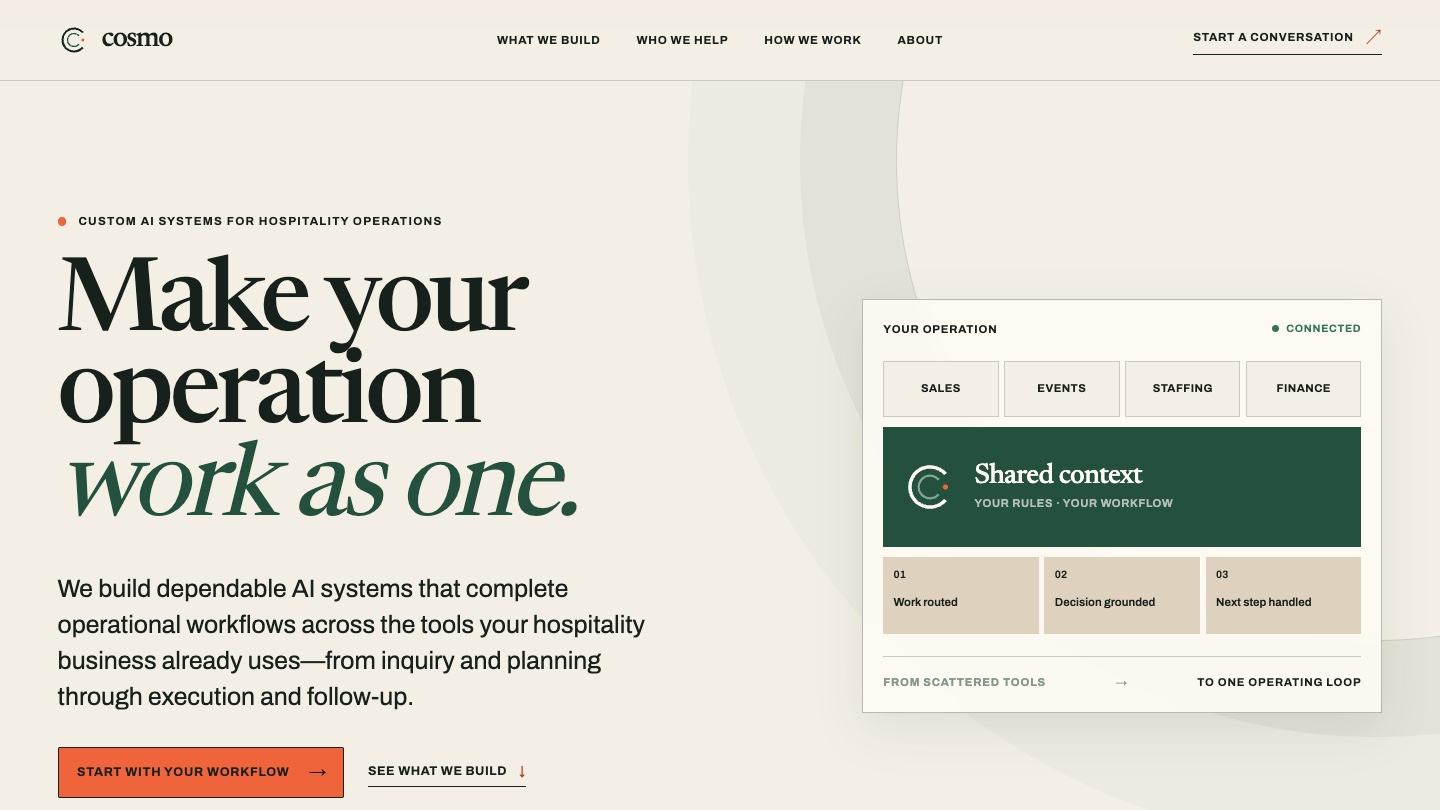
I first described Cosmo as an AI operating system for venues. Building it inside a real operation made the business more specific.
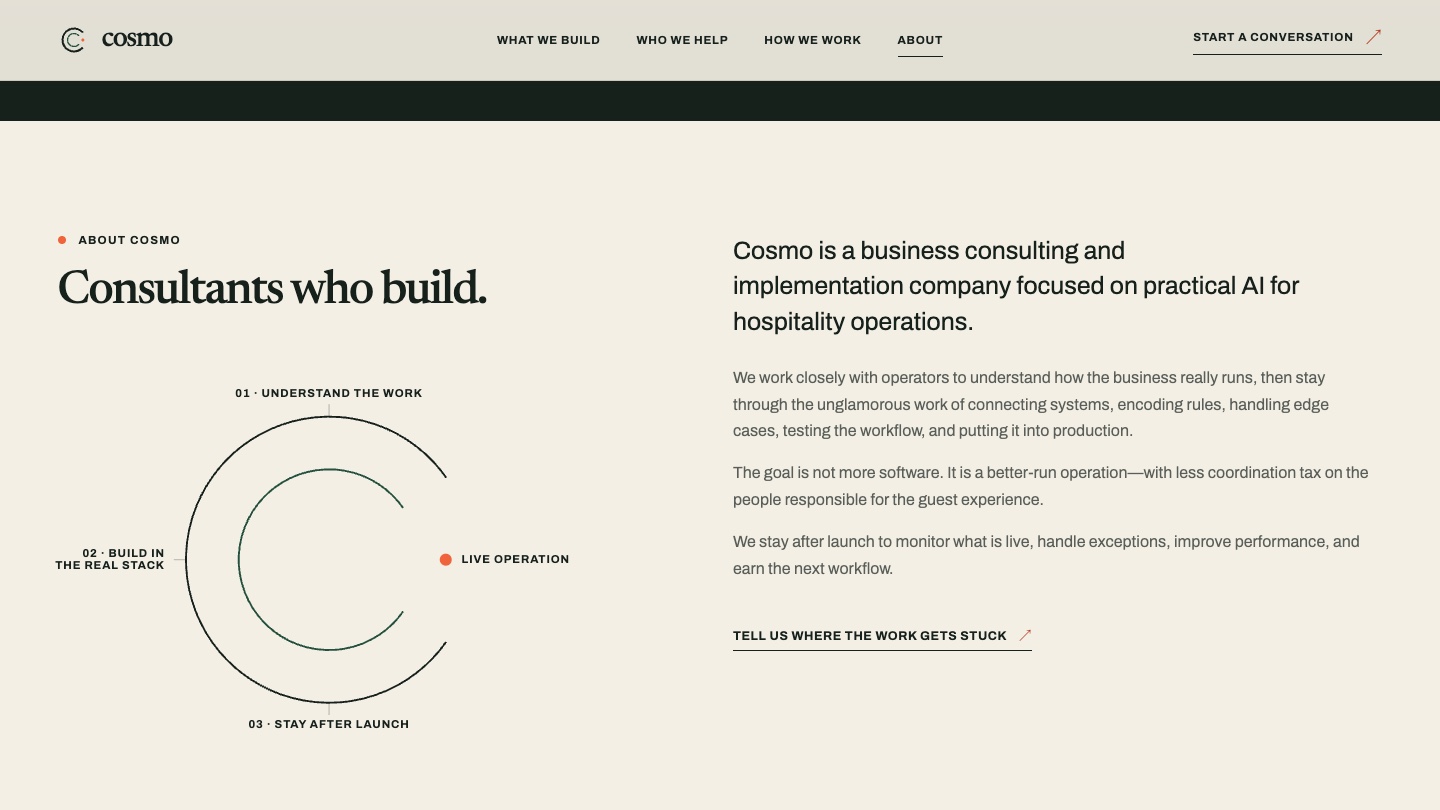
Cosmo is a consulting and implementation company. The unit of work is not a universal product or an isolated agent; it is one valuable operating loop, understood end to end, built into the real stack, launched with control, and improved from use.
The connected data layer and agents are still the technical shape underneath. The sharper direction is how they are delivered: around the operation, with the people responsible still in control.
The decisions behind it
Business and systemStart with the operation, not the AI
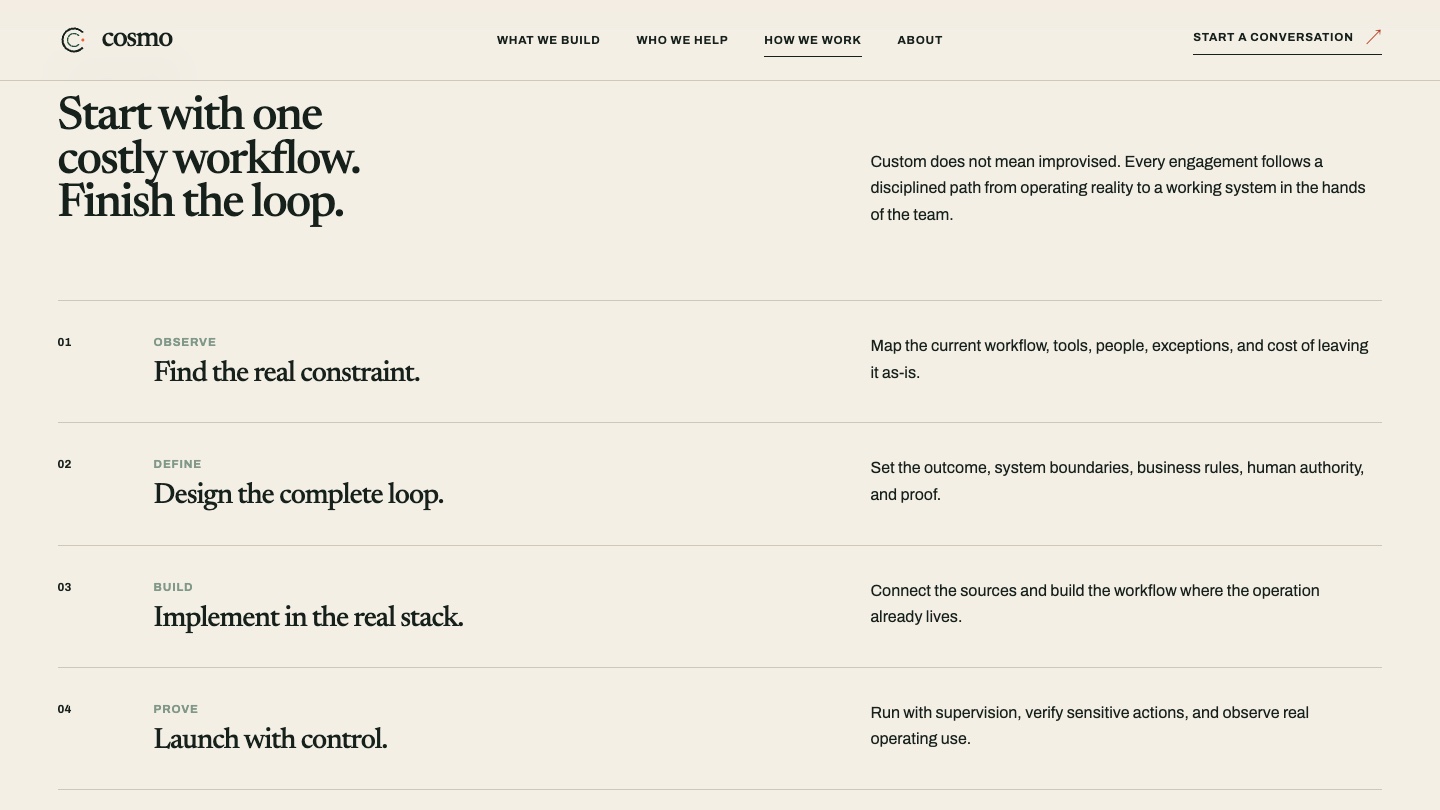
Every engagement begins by mapping one workflow: the people, tools, handoffs, exceptions, and cost of leaving it as-is. Only then do we decide where connected data, deterministic rules, AI, and human review belong. That keeps the technology subordinate to a business outcome.
Build around the stack already carrying the business
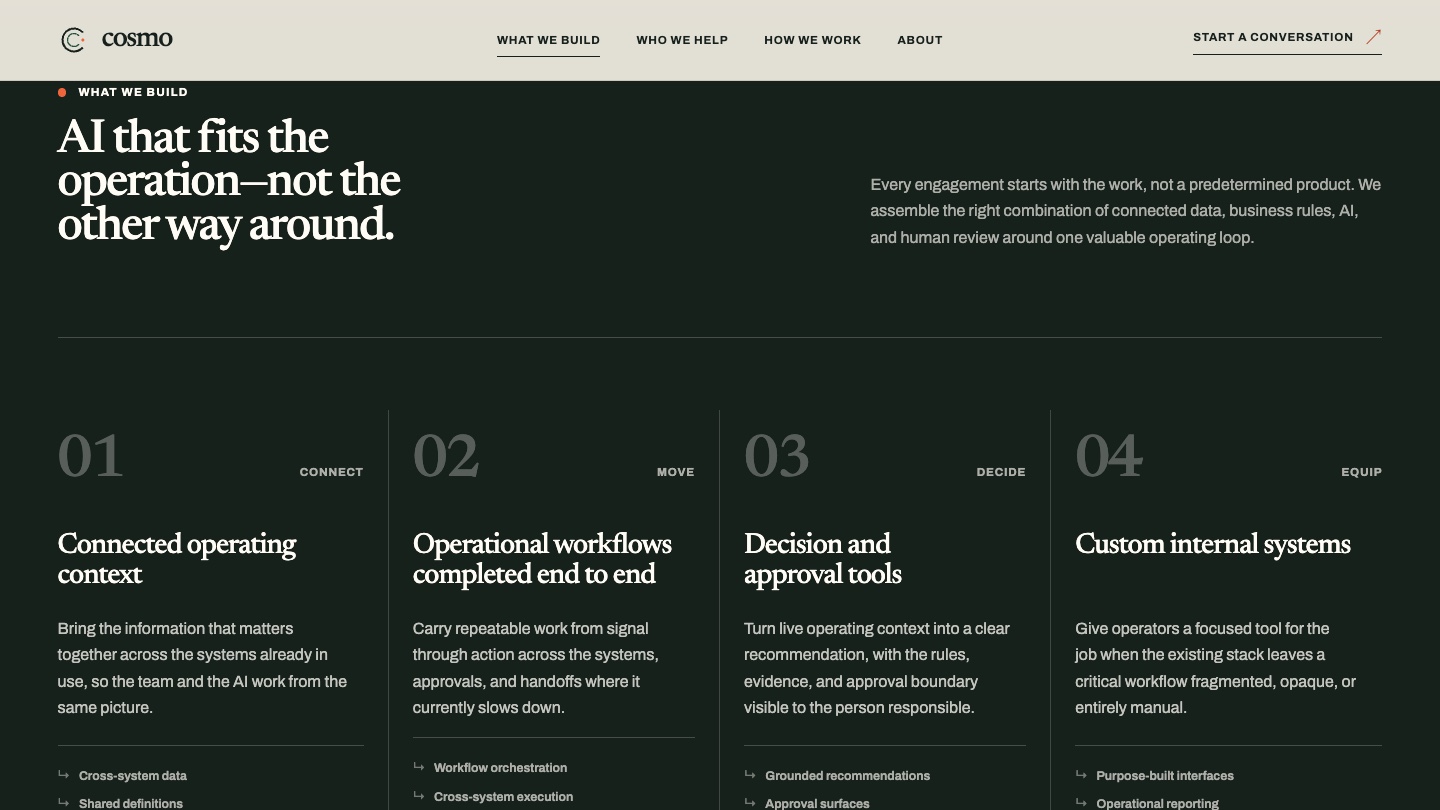
Restaurants and event spaces already run on point-of-sale, event, staffing, finance, inbox, and spreadsheet systems. Replacing all of them is rarely the answer. Cosmo joins the context that matters and carries the work across those boundaries, adding a focused internal tool only where the existing stack leaves a real gap.
Make authority visible
The system does not get blanket permission because it uses AI. Sensitive decisions stop at an explicit review point. Every recommendation carries its evidence and rules; every action can be traced; and autonomy expands only after a complete workflow has proved itself in real use.
Stay after launch
Cosmo is not a recommendations deck handed over at the end of discovery. We connect the systems, encode the rules, handle edge cases, launch with the team, and keep monitoring what is live. The next workflow is earned by improving the first one, not promised in advance.
Getting an agent to do a task is not the hard part. Getting one a venue can trust inside a live operation is. Most of the work is outside the model: shared definitions, deterministic calculations, permission boundaries, read-back verification, exception handling, and tests built around the cases that are easiest to get wrong.
The public marketing site is live. The connected data and workflow system behind it is being built in a real venue, one complete workflow at a time.
The connected data foundation is running against the venue's systems. The action layer and its trust controls are in build. The marketing site gives that work a clear public front door—and gives the business room to grow without pretending the whole vision is already shipped.
What this shows: I can turn a technical system into an operating proposition—researching the work, defining the business, designing the experience, and building the system underneath it.
I am the founder and lead the product, design, and build. Cosmo is an active venture, so this page will change as the business earns its next workflow.